

Expected supply
Stable
No current signs of global availability tension.
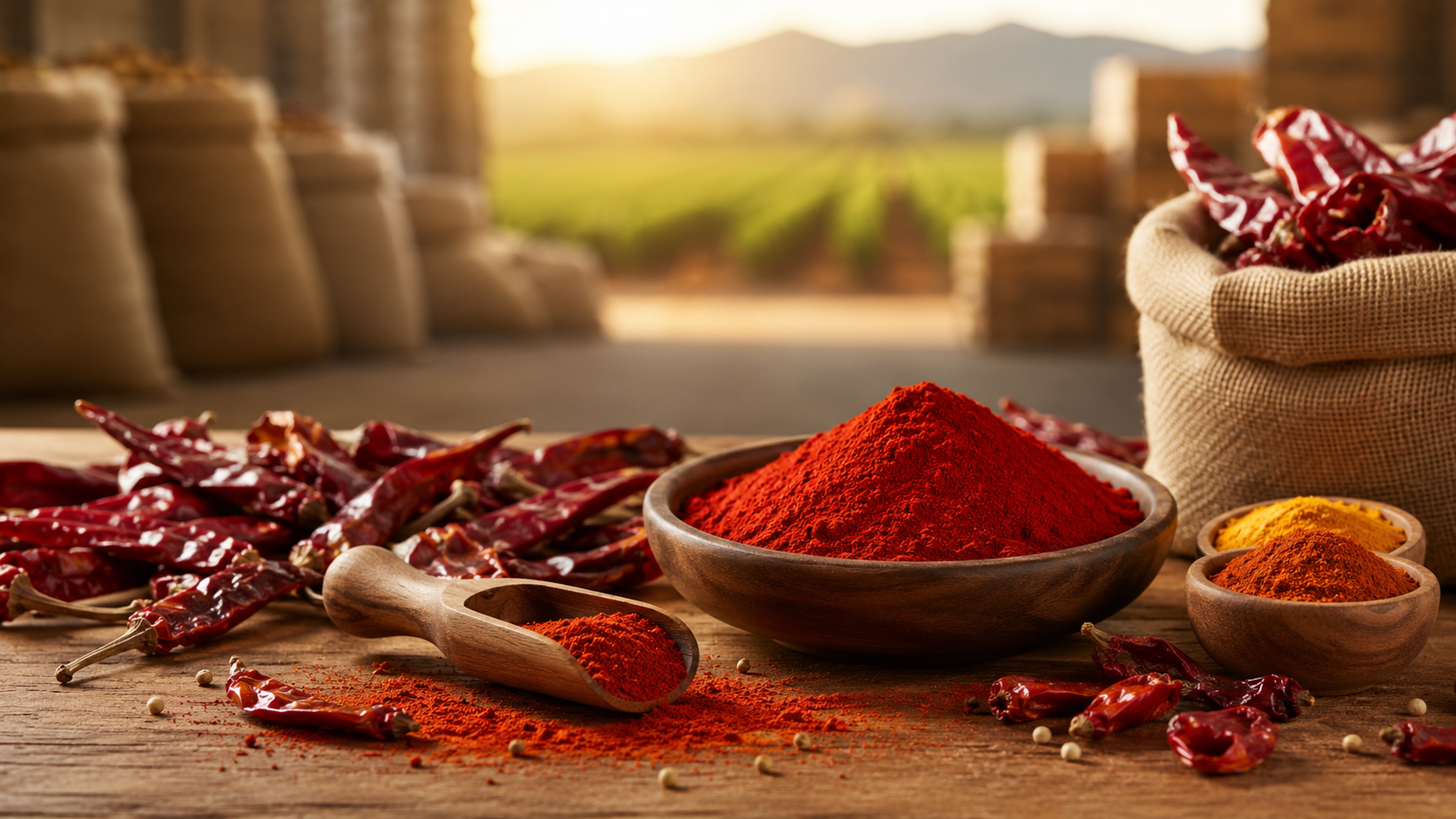
Crop, origin, cost and market variable analysis for international paprika buyers.
The 2026 crop season starts with a stable supply outlook in the main paprika-producing areas, although significant reductions are expected in certain alternative origins. At this stage, the market is not showing clear signs of shortage, but increasing pressure on agricultural costs may limit downward price corrections over the coming months.
No current signs of global availability tension.
Land rental and other costs are putting pressure on origin prices.
With slight upward pressure if industrial demand becomes more active.
| Factor | Current reading | Implication for buyers |
|---|---|---|
| Production | Potential similar to the previous crop season. | No immediate risk of shortage is currently visible. |
| Costs | Relevant increase in agricultural costs. | Less room for strong price decreases. |
| Origin | Greater focus on traceability and sourcing policies. | Global availability should be distinguished from availability by accepted origin. |
| Extraction industry | Its purchasing rhythm will be decisive. | It may tighten the market if activity increases over the next 2–3 months. |
| Related Capsicum | Cayenne has influenced paprika demand. | Related markets may transfer pressure to paprika. |
Sowing operations have progressed normally in the main production areas. Overall, expected production capacity remains at levels similar to the previous crop season.
However, the analysis should not be limited to total volume. Some areas with lower global weight, but relevant for certain customers due to origin criteria, traceability or internal sourcing policies, are showing significant acreage reductions.
For this reason, the correct reading is not only whether there will be enough paprika, but what type of availability will exist, in which origins, and under what level of documentary and analytical guarantee.
Stable global availability, with greater importance placed on selection by origin, quality and compliance.
The main change compared with previous crop seasons is the increase in production costs. The rise in agricultural land rental costs in the main growing areas is particularly relevant.
Commercial impact: although production potential remains stable, higher agricultural costs may make growers less flexible on price, especially at the beginning of the season.
The oleoresin extraction industry will be one of the key factors over the coming months. Its purchasing rhythm may directly influence raw material availability, especially if buying activity is concentrated within a short period.
A more balanced market and greater availability for food buyers.
Greater competition for raw material and possible upward price pressure.
Risk of temporary tension in availability and price.
In recent months, cayenne scarcity and high costs have triggered purchasing movements that have also affected the paprika market. Some cayenne buyers have expanded their interest toward other raw materials within the Capsicum group, creating additional pressure on specific qualities.
This behavior shows that paprika should not be analyzed in isolation. Tensions in other Capsicum categories may temporarily modify demand and alter market balance.
Weather will remain a key variable throughout crop development. At this initial stage, no relevant incidents have been identified that would alter the production forecast, but it is still too early to assess the final impact on yield, color, pungency or harvest timing.
Initial development remains within normal parameters.
Temperature, humidity, water availability, solar radiation and drying conditions.
Yield, color, pungency and lot arrival schedule.
Raw material origin remains a strategic criterion for many international buyers. In some cases, internal sourcing policies require differentiation not only by country of origin, but also by production area, documentary traceability and compliance guarantees.
Therefore, this report does not avoid geographical analysis: it contextualizes it. Production areas will be assessed according to their real impact on availability, quality, traceability, analytical compliance and customer acceptance.
For some buyers, a reduction in alternative areas may be more relevant than their share of total volume would suggest, especially where specific origin-based sourcing policies are in place.
At this stage, it is still too early to confirm final quality performance. No relevant changes are expected in the predominant varieties, although the final result will depend on weather, drying, varietal purity and lot selection.
To be confirmed with the first representative lots.
Varietal purity will remain decisive.
Traceability and analytical control will continue to make the difference.
Based on the information currently available, we do not see an immediate need to accelerate purchases due to shortage risk. However, we also do not expect a scenario of strong downward pressure while agricultural costs remain high and the extraction industry may activate relevant purchases over the coming months.
Maintain active market monitoring, secure availability in critical qualities, and avoid decisions based solely on the expectation of price decreases.
The 2026 crop season begins with stable potential supply, but with greater market complexity. Global volume does not appear to be the main risk at this stage; the most relevant factors will be agricultural costs, extraction industry activity, availability by accepted origin, weather evolution and analytical quality of the lots.
For international buyers, the key will not only be to purchase paprika, but to secure traceable raw material that is analytically compliant and aligned with their internal sourcing policies.
Overview of global spice market trends. Week 43 (2026). Key price movements by product.
Summary of global spices market trends. Week 39 (2026). Main price movements by product.
Summary of global spices market trends. Week 39 (2026). Main price movements by product.